
Astragaloside IV inhibits nasopharyngeal carcinoma progression by inhibiting SATB2/Wnt/PD-L1 pathway and enhancing the killing activity of T cells
All claims expressed in this article are solely those of the authors and do not necessarily represent those of their affiliated organizations, or those of the publisher, the editors and the reviewers. Any product that may be evaluated in this article or claim that may be made by its manufacturer is not guaranteed or endorsed by the publisher.
Authors
Astragaloside IV (AS IV) inhibits the malignant phenotype of nasopharyngeal carcinoma (NPC), but whether its mechanism involves the regulation of immune checkpoint programmed cell death-ligand 1 (PD-L1) is not clear. Human NPC cells were treated with AS IV. The effects of AS IV on PD-L1 expression were assessed using RT-qPCR and Western blot. SATB2/Wnt/β-catenin signaling axis regulation was analyzed by siRNA interference, plasmid overexpression and Wnt pathway inhibitor DKK-1. T cell killing activity and tumor malignant phenotype were evaluated by LDH release, ELISA, flow cytometry and Transwell experiments. huHSC-NCG tumor-bearing mice were established to detect tumor growth, immune cell infiltration and related protein expression. AS IV dose-dependently inhibited PD-L1 expressions within NPC cells, and enhanced the activation and killing function of CD8+ T cells. Mechanism studies have shown that AS IV significantly lowered the expression of SATB2, thereby inhibiting Wnt/β-catenin axis and c-MYC and Axin2 expressions, and ultimately reducing PD-L1 levels. Overexpression of SATB2 reversed AS IV's suppression of this signaling and PD-L1. Animal experiments confirmed that AS IV effectively inhibited tumor growth, enhanced CD8+ T cell infiltration and activity within tumor tissues, and down-regulated the SATB2/β-catenin/PD-L1 signal axis. AS IV inhibited PD-L1 expression in NPC via targeting the SATB2/Wnt/β-catenin axis, thereby activating CD8+ T cells, amplifying immunological responses, and ultimately inhibiting NPC growth.
Graphical Abstract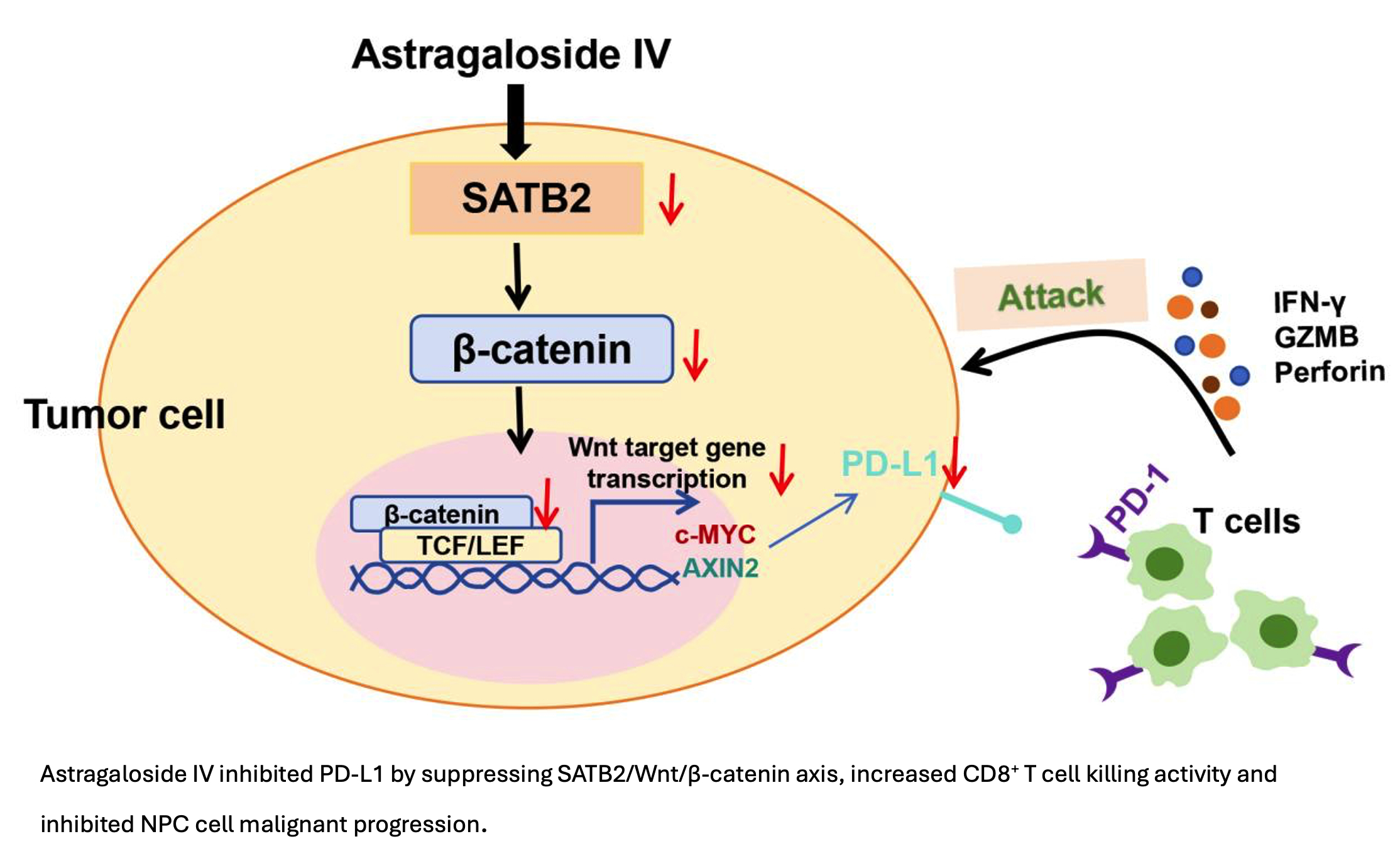
Downloads
Citations




CRediT authorship contribution
Yinping Zeng developed and planned the study, performed experiments, and interpreted results, edited and refined the manuscript with a focus on critical intellectual contributions. Jiajun Huang, Tingting Duan participated in collecting, assessing, and interpreting the data, made significant contributions to data interpretation and manuscript preparation. Xiaofeng Wang provided substantial intellectual input during the drafting and revision of the manuscript.
Supporting Agencies
Hainan Provincial Natural Science FoundationData Availability Statement
The data supporting the findings of this study can be obtained from the corresponding author, upon request.
How to Cite

This work is licensed under a Creative Commons Attribution-NonCommercial 4.0 International License.